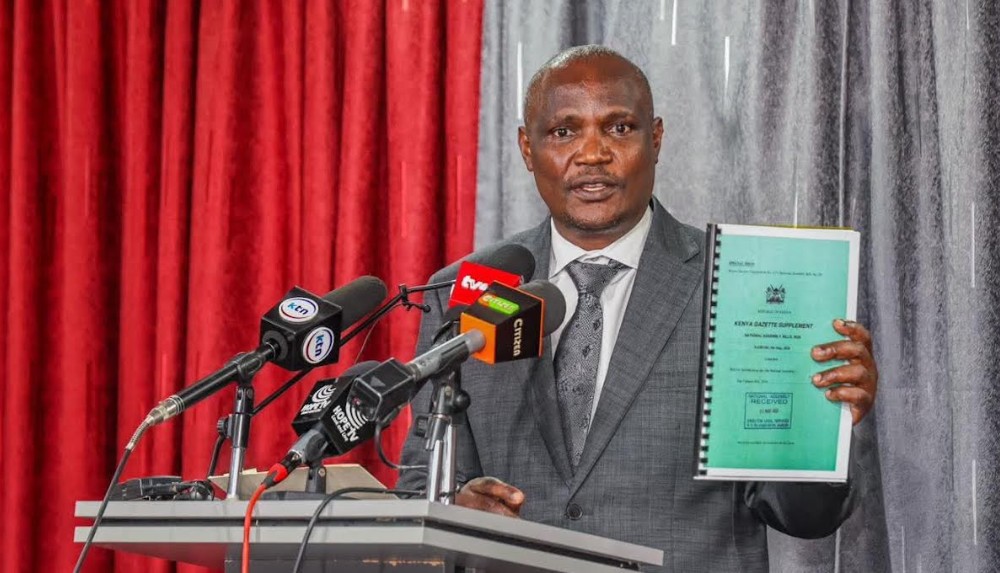
Treasury Defends Finance Bill 2026 Amid Public Tax Concerns
The National Treasury has defended the Finance Bill 2026, dismissing claims that it contains punitive or hidden taxes while clarifying several proposals that have generated public debate.
Treasury Cabinet Secretary John Mbadi said public participation remains a constitutional requirement in the legislative process, adding that discussions surrounding the Bill are part of normal democratic engagement.
Mbadi noted that some public commentary and media reports had inaccurately linked the Finance Bill 2026 to earlier or withdrawn tax proposals, leading to widespread misinformation.
He clarified that the Bill does not introduce VAT on bread, a motor vehicle circulation tax, eco-levy provisions, or government access to mobile money transaction data.
On mobile phone taxation, the CS explained that phones currently attract several levies, including VAT, excise duty, import duty, import declaration fees, and railway development levy, which collectively amount to about 55.5 percent.
According to Mbadi, the Bill proposes replacing the multiple charges with a single 25 percent excise duty to be applied when mobile phones are activated.
“The proposal seeks to simplify the existing structure by replacing multiple taxes with a single 25 percent excise duty on mobile phones,” he stated.
He added that the proposed framework would eliminate import duty, VAT, import declaration fees, and railway development levy on mobile phones to streamline tax administration and reduce complexity.
On digital finance, Mbadi said the Bill introduces a reporting framework for virtual asset service providers through amendments to the Tax Procedures Act, aimed at integrating digital assets into the formal tax system.
The CS explained that the move is intended to align digital transactions with existing financial reporting standards and ensure fairness across sectors.
Regarding digital payment systems, Mbadi said the Bill seeks to clarify taxation on fees charged by payment platforms and card providers following court rulings that created uncertainty around interchange fees and related services.
He also dismissed claims that the Bill introduces a five percent withholding tax on digital content monetisation, saying the provision does not exist in the Finance Bill 2026.
Mbadi further clarified that Safaricom and other mobile money operators are not the target of the proposed reforms, noting that the focus is on digital intermediaries and service providers.
The Treasury CS maintained that the reforms are guided by fairness, equity, and simplicity, with the aim of broadening the tax base while supporting economic stability.
He urged Kenyans to continue participating in the legislative process, assuring stakeholders that consultations would continue before Parliament makes its final decision on the Bill.